
New Ofcom Research Reinforces the Need for Open Conversations Around Online Gaming
Online gaming remains one of the most popular activities for children and young people across the UK, offering opportunities for social connection. However, new findings from Ofcom’s Growing Up Gaming report highlight the importance of helping children navigate the social aspects of gaming safely and confidently.
The research found that 88% of children aged 3-17 play games on a device, while more than half (55%) of young gamers say they play online with people they have never met in person. One in five (20%) report doing this all or most of the time.
Alongside these findings, parents identified communication with strangers as their leading concern. Almost two-thirds (64%) said they worry about their child talking to unknown individuals through games or in-game chat features, placing it above concerns about bullying (60%), inappropriate content (59%) and spending pressures within games (51%).
Turning Concern into Action
While parents are clearly aware of the potential risks associated with online interaction, the research suggests many families are yet to put specific safeguards in place around who children can play with online.
Fewer than half of parents (43%) say they have rules about who their child can interact with while gaming. In contrast, families are more likely to set boundaries around screen time (56%), when gaming can take place (51%) and the types of content children can access (50%).
These findings highlight that online safety discussions should extend beyond managing time spent online. Understanding the social side of gaming is increasingly important as online play becomes a core part of young people’s lives.
Gaming Is About More Than Playing
For many children, online games provide valuable opportunities to communicate, build relationships and develop digital skills. However, these interactions can also expose young people to experiences they may not be prepared to manage on their own. Children may not always recognise when behaviour is inappropriate, when someone is attempting to manipulate, or when an online interaction has crossed a boundary.
This is why the role of parents, carers and trusted adults remains so important. Safety tools and platform protections can help reduce risk, but ongoing conversations help children develop the confidence and critical thinking skills needed to navigate online spaces safely.
Creating Space for Meaningful Conversations
At the UK Safer Internet Centre, we encourage parents and carers to take an active interest in children’s online lives, including the games they play and the communities they are part of.
Conversations about gaming work best when they focus on interest and engagement rather than interrogation. Showing curiosity about what children enjoy can help create an environment where they feel comfortable discussing both positive and negative experiences. Simple questions can help open up these discussions:
– What games have you been enjoying recently?
– Who do you usually play with?
– What do you like about that game?
– Have you ever seen or heard something online that made you feel uncomfortable?
– Do you know what to do if someone is being unpleasant or inappropriate?
– Would you know how to block, mute or report another player?
When gaming becomes a regular topic of conversation, children are often more willing to seek support if they experience something concerning.
Check, Chat, Change
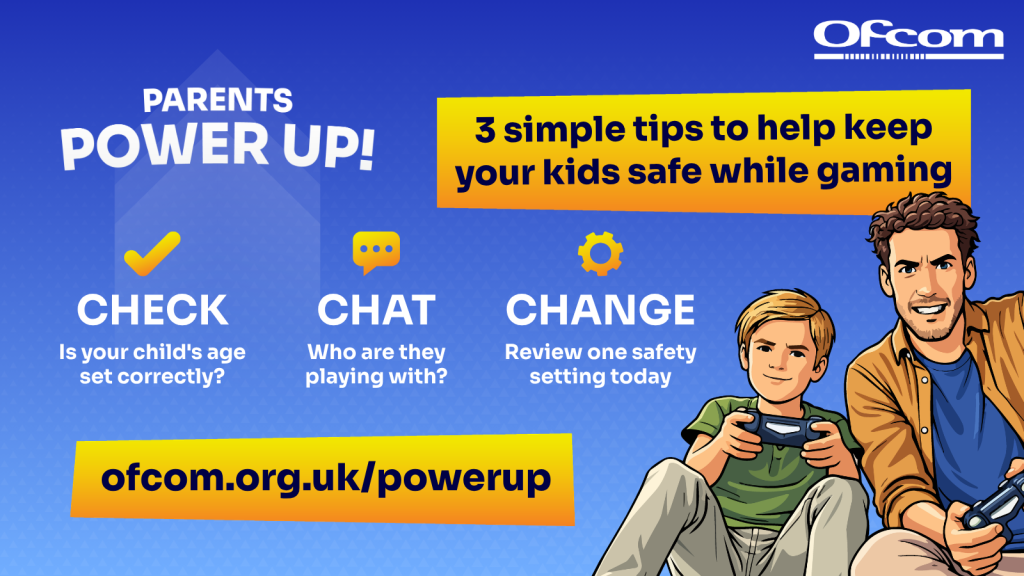
To support this, Ofcom has launched a pilot campaign called Power Up, encouraging parents to adopt three simple actions: Check, Chat and Change.
Check the safety settings on games and devices, including privacy controls, communication settings and age-appropriate restrictions.
Chat regularly about gaming experiences, friendships and any concerns children may have.
Change settings or family agreements when needed, whether that’s limiting contact from unknown players, enabling additional safety tools or reviewing spending controls.
As part of Power Up there are challenges and family activities that young people can get involved with new resources launching later this month.